You read three guides on how to start a pet supply store. You made a business plan, calculated your startup cost, and signed a lease. Six months later, you're still not hitting your target.
The guides didn't lie. They just weren't written for you.
Almost every "how to start a pet store" guide online was built for the US market — where customers buy 20kg bags at a time, pay by card, and stores run on POS systems that cost more than a month's rent in Quezon City. If you're asking paano magsimula ng pet store Philippines, the honest answer is: the rules are different here. And the parts that are different are exactly the parts that will make or break you.
Here are four things those guides won't tell you — and what to do about each one.
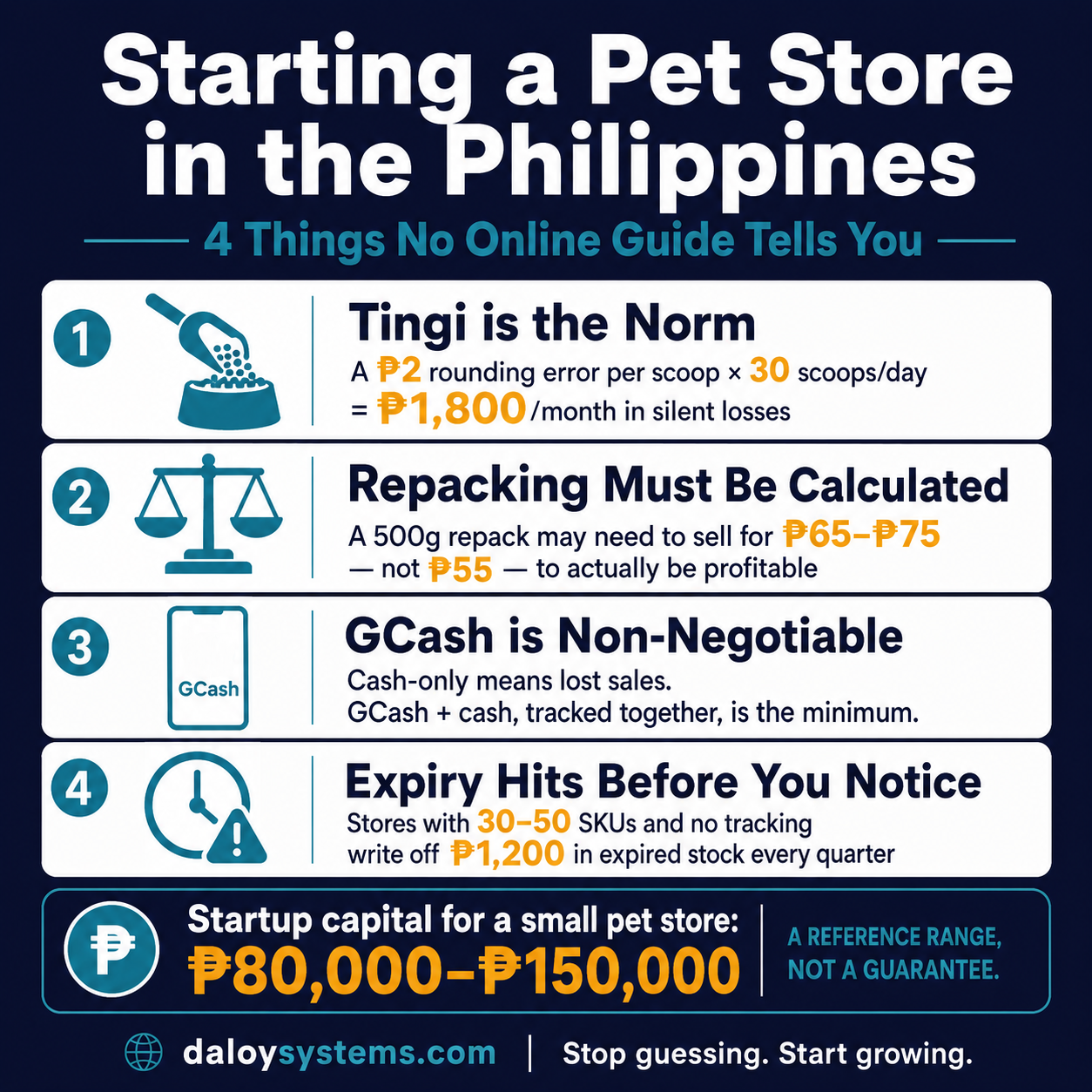
1. Your Customers Buy Tingi, Not Bulk
In the US, bulk is the default. A customer walks in, grabs a 15-pound bag of kibble, and you're done. In the Philippines, a huge portion of your customers — especially in the early months — will ask for tingi. A small scoop. Enough for a few days. Enough for what they can afford today.
This isn't a niche. This is your actual customer base.
The problem is that most new pet store owners price tingi intuitively. They look at the bag, guess a per-gram rate, and round it to something that feels right. Sometimes that works. Often it doesn't — and they don't find out until the bag is gone and there's less money in the register than expected.
Tingi pricing has to be calculated, not guessed. Take the cost per gram of the product, add your markup, round to the nearest clean selling unit (₱5, ₱10, ₱20), and check if the math still works after that rounding. A ₱2 rounding error per scoop across 30 scoops a day is ₱1,800 a month in silent losses.
If you're repacking and selling by the gram or by the cup, the same logic applies — which leads us to the next one.
2. Repacking Is Standard Practice — Treat It Like a Business
Bulk repacking of dog food is common in Philippine pet stores. You buy a 20kg bag of dry kibble, repack it into 250g, 500g, or 1kg portions, label them, and sell at retail. Done right, it's a legitimate margin driver. Done wrong, it's a quiet way to lose money.
The math has to be done per portion, not per bag.
Here's a basic example: if you pay ₱1,800 for a 20kg bag, your raw cost is ₱90/kg or ₱9/100g. Add your packaging cost (bag + label + tape = maybe ₱3 per pouch), your overhead allocation, and your target margin. A 500g repack might need to sell for ₱65–₱75 to actually be profitable — not ₱55 because that "feels fair."
Most owners who repack don't have a calculator for this. They estimate based on what competitors charge. That's fine as a market check, but it's not a margin plan.
If you want a ready-made tool to run this, the Repack Margin Calculator for Pet Stores walks through the exact formula — including packaging cost and spoilage buffer.
3. If You Don't Accept GCash, You're Losing Sales Right Now
This one is simple and non-negotiable.
GCash is the primary payment method for millions of Filipino consumers. Your customers will walk in, pick up their order, and reach for their phone. If you tell them cash only, a significant percentage will put the item down and leave — not because they don't want it, but because they genuinely don't have cash on them.
The DTI reports that micro and small enterprises make up over 99% of Philippine businesses, and digital payments have become the expected baseline — not a premium feature.
Accepting GCash doesn't require a fancy setup. At minimum, a QR code on the counter works. But if you're processing more than 20 transactions a day, you want something that logs it — otherwise your end-of-day cash-out becomes a reconciliation headache.
Card-only setups have the opposite problem. Cards still aren't universal in the mass market. The sweet spot for a Philippine pet store is: cash + GCash, tracked together. If you want more detail on how to choose a payment-integrated setup, How to Choose a POS System for Your Pet Store covers what to look for.
4. Pet Food Expiry Will Quietly Eat Your Profit
This one hurts because it's invisible until it isn't.
Dry kibble typically has an 18-month shelf life from manufacture. Wet food — canned, pouch, fresh — can be anywhere from 2 to 12 months. Premium and grain-free lines sometimes have shorter shelf lives than mid-market products because of fewer preservatives.
Here's how the loss happens: you buy a batch, stock the shelves, sell the fast-moving SKUs, and the slow ones sit. You reorder based on what sold. The slow ones get pushed to the back. Six months later you do an inventory check and find ₱1,200 in expired wet food that nobody flagged because nobody was tracking it.
That's not an unusual number. For stores that carry 30–50 SKUs without expiry tracking, that kind of write-off happens every quarter.
FIFO (first in, first out) is the discipline: new stock goes behind old stock, always. But FIFO only works if you also know what's coming close to expiry — so you can discount it, promote it, or pull it before it becomes a total loss.
The Hidden Cost of Expired Cat Food breaks down exactly how this adds up over a year, with real numbers.
How Daloy Helps With All Four
Daloy is a POS system built specifically for Philippine pet stores. It handles tingi pricing (including per-gram costing), tracks repacked portions as separate SKUs with their own margin, logs GCash and cash payments together in one register view, and lets you set expiry alerts by batch so nothing reaches its date unnoticed.
It's not the only tool that can do these things. But it's one of the few built with Philippine pet store realities in mind — not ported from a US retail template.
Frequently Asked Questions
Q: How much capital do I need to open a pet supply store in the Philippines?
A: A small neighborhood pet supply store typically needs ₱80,000–₱150,000 to start — covering initial inventory, shelving, signage, and a modest operating fund. Location and store size will shift this significantly. Kiosk setups in markets or wet market extensions can start lower; standalone spaces in commercial areas will need more.
Q: Should I buy dog food in bulk or per bag?
A: Bulk buying improves your margin per kilo but requires proper storage and faster turnover to avoid spoilage losses. Start with mid-sized quantities (5–10kg bags) until you know which brands move in your area, then move to bulk for your top 3–5 SKUs once turnover is confirmed.
Q: How do I price tingi or repacked dog food?
A: Calculate cost per gram from the bulk price, add packaging cost per portion, then apply your target margin (typically 25–40% for pet food). Round to the nearest clean selling denomination. Don't price based purely on competitor comparison — their margins might already be wrong.
Q: What payment methods should my pet store accept?
A: Cash and GCash at minimum. Maya is also widely used and worth adding. Card terminals are optional unless you're in a high-foot-traffic commercial area with a customer base that shops more on credit. The key is that all payment channels reconcile in one place at end of day.
Q: How do I manage pet food expiry dates in my store?
A: Log batch expiry dates when stock arrives, apply FIFO strictly (new stock behind old), and set a 30-day warning threshold so you have time to clear stock before it expires. At minimum, do a weekly expiry sweep on wet food and a monthly check on dry. A POS with batch tracking makes this automatic.
Running a pet store in the Philippines is very doable — but only if you're running it by Philippine rules, not a template written for somewhere else. Tingi pricing, repack margins, GCash acceptance, and expiry tracking are the four things that separate stores that grow from stores that grind.
Try Daloy free for 30 days.
Tingi costing, repack margins, GCash + cash tracking, and expiry alerts — built for Philippine pet stores. No credit card needed.
Start your free trial →30 days · Up to 100 products · No card needed